

Film and TV Adaptations: 10 Sources Beyond Novels
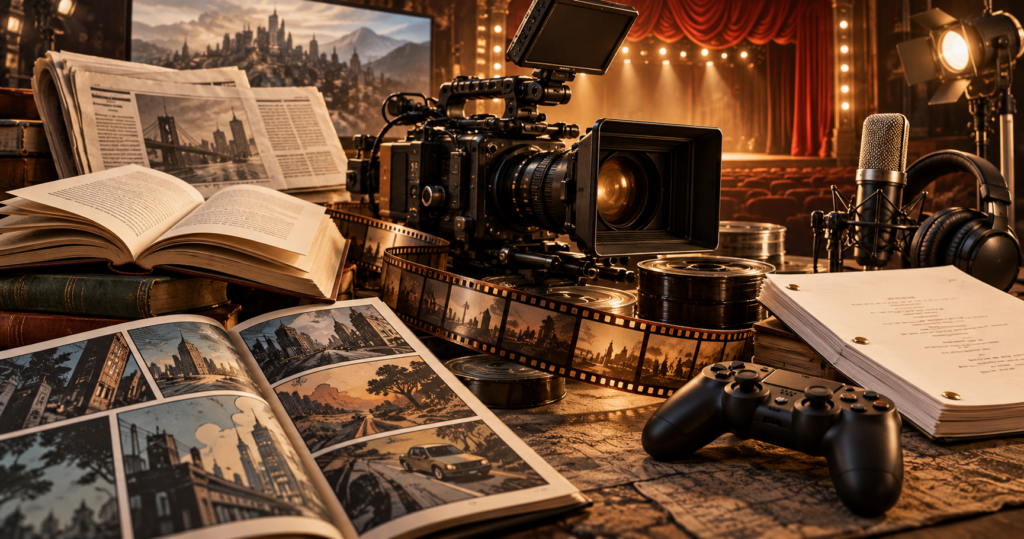
A compelling screen story does not have to begin as a novel. Film and television adaptations can originate in stage plays, short stories, journalism, comic books, video games, podcasts, folklore, and earlier screen productions.
Each source offers different creative possibilities. The work of adaptation involves identifying what makes the original compelling and discovering how its characters, conflicts, ideas, or world can engage an audience in another medium.
What Is a Screen Adaptation?
A screen adaptation develops an existing work or property into a film or television production. It may closely follow the original narrative, reorganize its events, or create a new story within an established fictional world.
Adaptation also differs from drawing inspiration from a subject. A screenplay about a historical event may be developed through research, while another film about that same event may specifically adapt a published book or article.
That distinction helps explain why stories with similar subjects can have very different creative foundations. The source material influences what the writer begins with and what still needs to be developed.
1. Stage Plays and Musicals
Theater offers characters, conflict, dialogue, and sometimes music that have already been shaped for performance. However, moving a production to the screen requires decisions about how the camera, editing, and locations will contribute to the storytelling.
Chicago illustrates this process. Its film adaptation draws from the stage musical, which itself developed from Maurine Dallas Watkins’s play inspired by actual murder trials. One story can therefore travel through several forms before reaching the screen.
A film adaptation can move beyond the physical boundaries of a stage, but adding locations is not automatically an improvement. The challenge is to preserve the dramatic energy while making deliberate use of the screen.
2. Short Stories and Novellas
Shorter fiction can provide a concentrated conflict, a memorable character, or an ending that suggests a larger cinematic experience. A work does not need hundreds of pages to contain the foundation for a feature film.
The Shawshank Redemption, for example, grew from Stephen King’s novella Rita Hayworth and Shawshank Redemption. Its journey to the screen demonstrates the possibilities within fiction shorter than a full-length novel.
Adapting shorter fiction may require expanding relationships, developing additional scenes, or making an internal struggle visible. Those additions work best when they deepen the original conflict rather than simply increase the running time.
3. Journalism and Reported Articles
A reported article can introduce an extraordinary situation, a hidden community, or a conflict with consequences beyond the people immediately involved. Interviews and documented events can provide a starting point for dramatic development.
Hustlers developed from Jessica Pressler’s reporting for New York magazine. The adaptation shows how a journalistic account can become the basis for a character-centered feature film.
The creative task involves choosing a point of view and shaping the material into scenes. A report may explain what happened across several years, while a film needs to establish how selected moments connect and why they matter to the people involved.
4. Biographies, Memoirs, and Historical Accounts
Nonfiction books also provide adaptation material, although their starting point differs from invented fiction. A biography follows a life through research, while a memoir presents experiences through the author’s own perspective.
Oppenheimer specifically adapts American Prometheus, the biography by Kai Bird and Martin J. Sherwin. This makes it both a film about historical events and an adaptation of an identified written work.
A person’s entire life rarely fits comfortably into one film. Development often begins by selecting a defining period, relationship, or dilemma that gives the screen story a clear focus.
Historical events can also inspire original dramatic stories without a single source text serving as their foundation. For that reason, “based on history” and “adapted from a book” should not be treated as interchangeable descriptions.
5. Comic Books and Graphic Novels
Comic books and graphic novels bring together visual composition, dialogue, character, and narrative. They may offer an established visual identity, but their images still require interpretation when translated into moving pictures.
Adaptations in this category extend beyond superheroes. Bryan Lee O’Malley’s Scott Pilgrim graphic novels, for example, also provide the basis for the animated television series Scott Pilgrim Takes Off.
A reader controls the pace of a comic, lingering over a panel or turning a page quickly. A screen production must establish its own timing through performance, movement, sound, and editing.
6. Video Games
Video games can supply distinctive worlds, characters, conflicts, and visual environments. Their adaptation presents a particular challenge: a viewer watches the action rather than making the choices that move it forward.
The television series Fallout draws from the game franchise while developing a story within its world. It demonstrates that adapting a game property does not necessarily mean recreating one game’s plot scene by scene.
The writer must decide what makes the experience recognizable and engaging without player participation. That may involve preserving the world’s atmosphere and central tensions while giving the screen characters their own goals and consequences.
7. Folk Tales, Fairy Tales, Myths, and Legends
Traditional stories offer characters and conflicts that have been retold across generations. Tales of transformation, forbidden knowledge, impossible tasks, loyalty, and betrayal can support many different interpretations.
Arthurian legends, for example, offer a broad body of stories rather than one definitive narrative. A filmmaker can choose a particular character, relationship, or episode as the center of a new telling.
It is useful to distinguish traditional material from a specific author’s work. The Jungle Book, despite its association with animal tales, originates in Rudyard Kipling’s stories; a screen version of Macbeth adapts Shakespeare’s play.
The creative opportunity lies in deciding what the new telling contributes. A different perspective, setting, or emphasis can reveal something that earlier versions left unexplored.
8. Podcasts and Audio Drama
Audio storytelling creates a world through voices, sound, and the listener’s imagination. A screen adaptation must decide how much of that world to reveal and how its visual choices will affect suspense, intimacy, and perspective.
Homecoming began as a scripted Gimlet podcast before becoming a television series. Its transition required developing visual storytelling around material originally experienced through sound.
A screen version does not need to illustrate every spoken detail. It can use behavior, setting, and visual contrast to communicate information that the audio production delivered through conversation.
9. Digital Stories and Social Media
A story published online can also become adaptation material. Personal essays, serialized narratives, and social media accounts may introduce a distinctive voice or a sequence of events that supports further development.
Zola emerged from A’Ziah “Zola” King’s viral Twitter account of a Florida trip. Its unusual origin demonstrates that a story’s first publication format does not determine the limits of its screen potential.
Online attention alone does not create a complete screenplay. The development process still needs to examine character, perspective, structure, and what gives the narrative meaning beyond the initial reaction.
10. Previous Films and Television Shows
An existing screen work can become the source for another production. Remakes may move a story into a different language, culture, period, or setting, while a television-to-film adaptation must reshape material for a different running time and structure.
The Departed reworks the Hong Kong crime thriller Infernal Affairs. It is an example of adapting an existing film through a different cultural and dramatic setting.
The terms remake, reboot, sequel, and adaptation describe different relationships to earlier material. A remake retells an existing story, a reboot restarts a property’s continuity or approach, and a sequel continues it; those categories can sometimes overlap.
What Makes Material Worth Adapting?
Recognizable source material can provide a starting point, but recognition alone does not solve the creative work. The material needs a compelling reason to exist in its proposed screen form.
Useful development questions include:
- Whose experience will guide the audience?
- What central conflict can sustain the story?
- Which elements make the source distinctive?
- What can performance, images, and sound add?
- What needs to change for the new format?
- Does the material suggest a feature, a short film, or a series?
A brief story may contain a powerful film, while a much longer work may need substantial compression. The aim is to identify the story’s essential appeal and build a screen experience around it.
Explore Your Story’s Adaptation Possibilities
A book is one of many places a screen story can begin. A play, article, audio drama, or other existing work may also offer characters and conflicts ready for creative development.
Allwrite Productions helps explore those possibilities through story development, writing, and adaptation. Contact us to discuss your source material, your vision, and the next step toward shaping it for the screen.